


They arrived in Ledići believing they were coming to an abandoned mountain village, hidden somewhere between Bjelašnica and forgotten roads. An article they had read online sparked their curiosity, and even before reaching Sarajevo, they decided to turn towards the village they had read about.
Before arriving in Ledići, they had visited Trebinje, Mostar and Konjic, while this was their very first time in Bosnia and Herzegovina. Her name is Lottie and she comes from New Zealand. She holds a master’s degree in landscape geography and is especially interested in rural areas, sustainable development and the relationship between people and nature. Ergent is from Albania and has years of experience in project management. Together, they travel across the Balkans, exploring its natural beauty, small communities and stories rarely found in tourist guides.
They parked their car right in front of the Small Family Home in Ledići and began exploring the village. They stopped in front of a sign explaining that the Small Family Home is located in a house declared a national liberation war monument, where Josip Broz Tito once held a session of the Central Committee and spent the night during the war years.
However, what surprised them the most was something entirely different — the fact that the village was not completely abandoned. They expected silence and emptiness, but instead found cultivated gardens, smoke rising from chimneys, and people who still come here, plant, repair and try to bring life back to a place that had almost been forgotten for years.
The director of Foundation Second Belma Mujezinović was working the land near the house when they approached her, looking for more information about the village. During the conversation, she explained that Ledići is not an abandoned place, but rather a village that is slowly coming back to life thanks to people returning to it and the projects being developed there. She also shared the story of philanthropist Alija Mulaomerović, whose Foundation proBITRA donated the house and land to the Public Institution Home for Children Without Parental Care Sarajevo, making it possible to create the Small Family Home — a place intended for children without parental care, children from at-risk families and various non-institutional care and nature-based support programs.
They were especially touched by the idea that children here learn what life outside an institution can look like — through cooking together, spending time in nature, gardening, caring for animals and completing small daily responsibilities that create a sense of belonging and home.
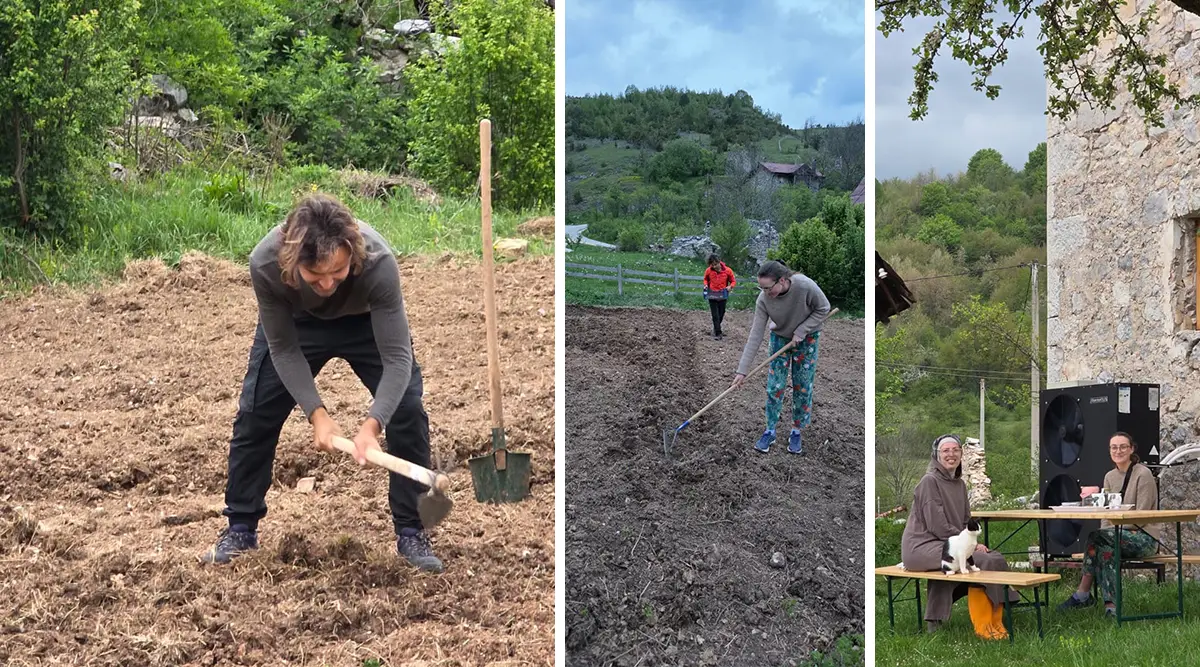
After the conversation and village tour, they wanted to contribute something themselves to the place that had welcomed them so unexpectedly. Together with the director of Foundation Second, they worked the soil and planted a row of potatoes, laughing that they now “have a reason to come back one day and see what has grown.”
They worked until sunset, and ended the day with a shared dinner to which the director of Foundation Second invited them after the work in the garden. With homemade food and tea made from wild thyme picked in Ledići, the conversation continued late into the evening — about travel, nature, children, the Balkans and small places that, despite everything, still preserve life.
They left the village they once thought was abandoned with a completely different feeling — that for a short while, they had become part of a small community that is slowly growing again.