


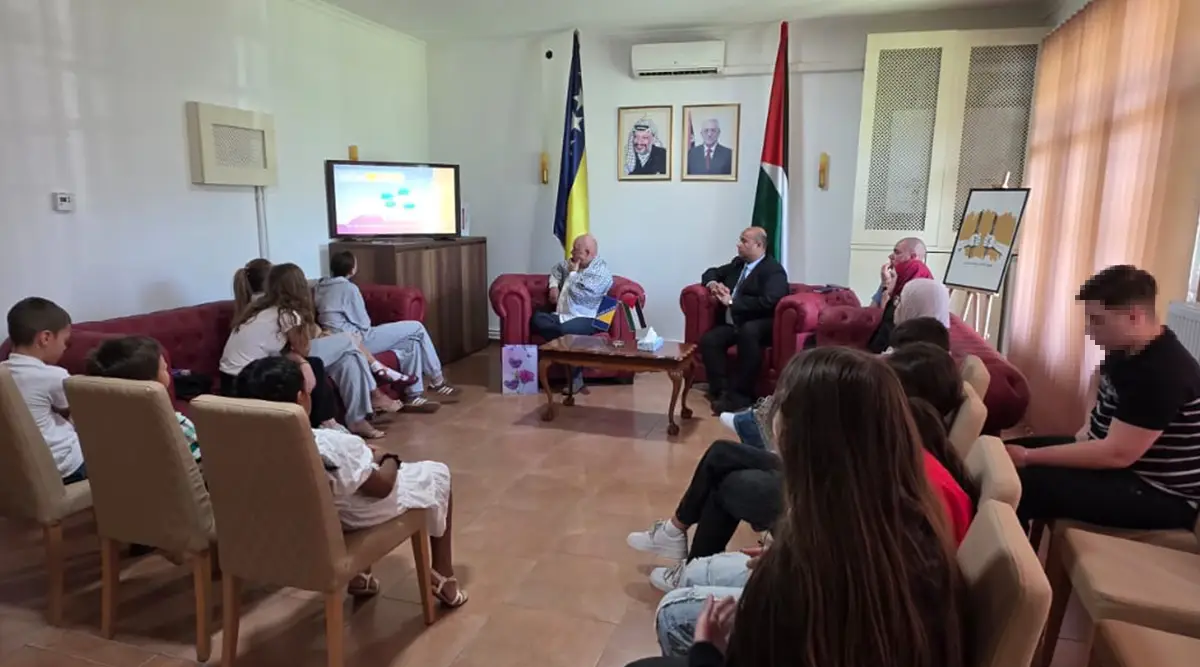
At the invitation of the Embassy of the State of Palestine in Bosnia and Herzegovina, children from the Sarajevo Home for Children Without Parental Care visited the Embassy's premises in Sarajevo today together with the Home's Director, Muhamed Musić. The visit was also attended by Belma Mujezinović, Founder and Director of Foundation Second, which has been working closely with the Home for several years through numerous projects dedicated to children without parental care.
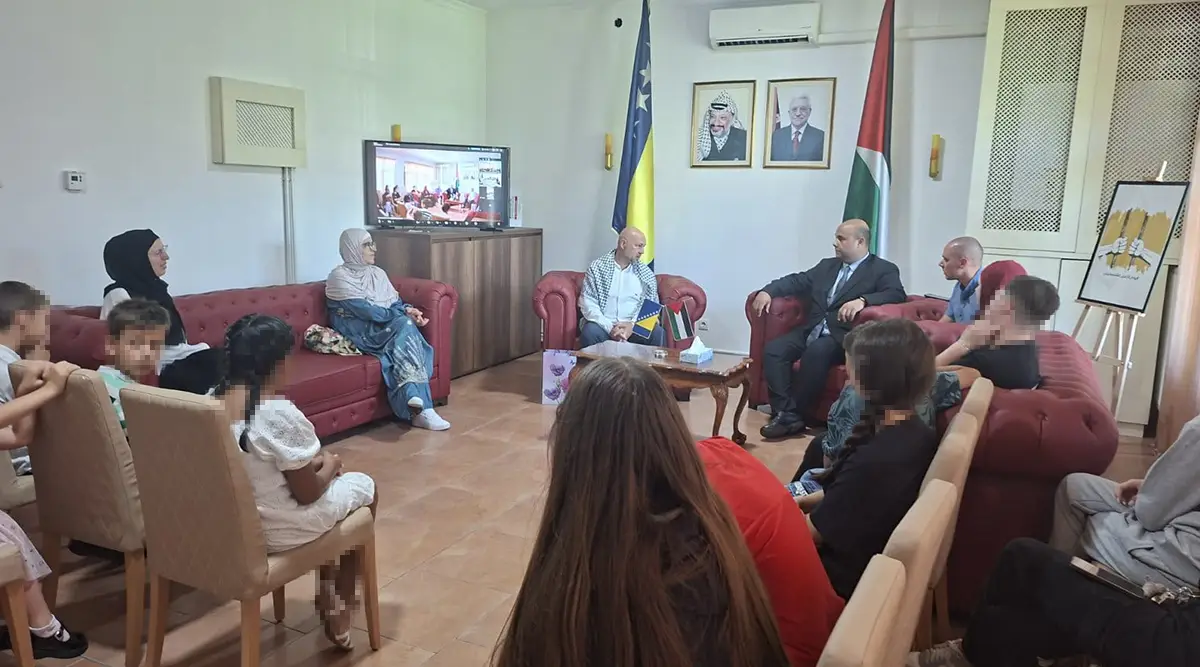
The guests were warmly welcomed by Mohammed Albarrawi, First Secretary of the Embassy of Palestine, and his colleagues. The central part of the visit was a video conversation lasting more than an hour with children from a Palestinian association operating in a refugee camp in the occupied West Bank.
During the conversation, the children from Sarajevo and Palestine introduced themselves, talked about their schools, hobbies, daily lives and dreams. It was a sincere meeting between children growing up in completely different circumstances, yet sharing the same wish—to live in peace, feel safe, and have the opportunity to learn, develop their talents and build a better future.
The Best-Educated Children in the Middle East
The association they spoke with supports around 3,000 children through educational, sports, cultural and creative activities that help them find a sense of security and experience as normal a childhood as possible despite the difficult circumstances in which they are growing up.
Speaking about their work, the First Secretary of the Embassy of Palestine emphasized that education is the Palestinian people's greatest strength.
"The greatest gift we can give our children is education. Education is our strongest form of resistance. Despite all the challenges we face, our children are among the best educated in the Middle East. In our small classrooms, as many as sixty children often study together, yet their desire for knowledge never fades."
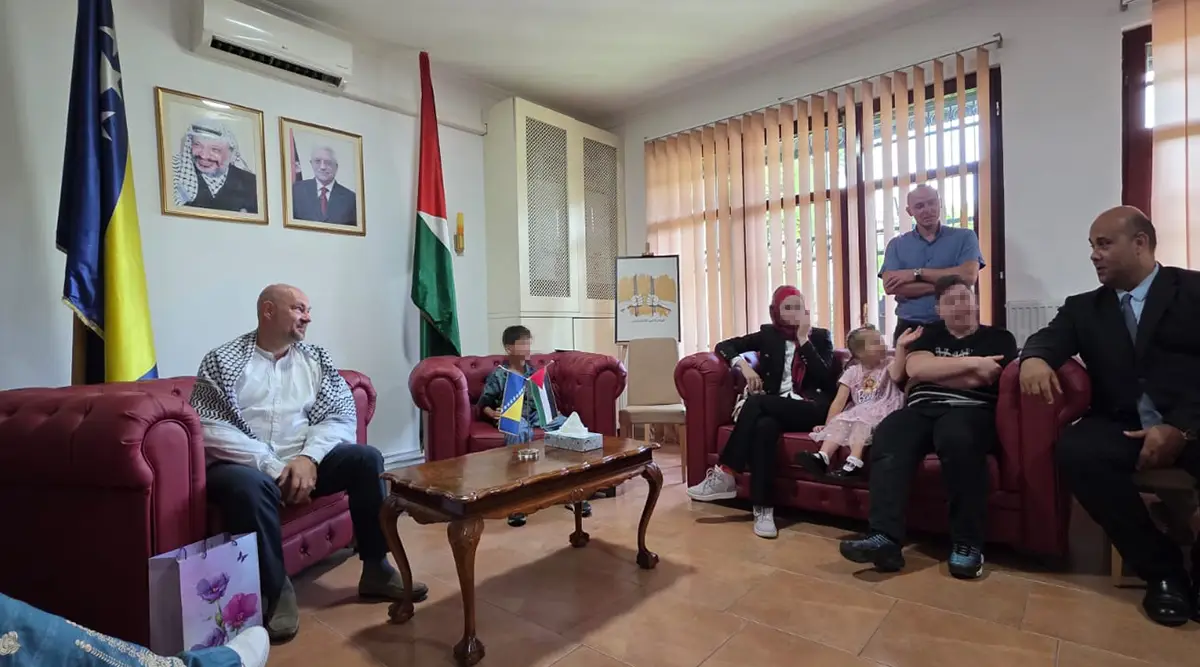
His words carried even greater weight when he shared part of his own life story. He lost his father at the age of four and, during the occupation, lost around thirty members of his immediate and extended family. Despite his personal tragedy, he dedicated his life to working with children, believing that knowledge, dignity and education are the strongest response to violence and injustice.
He explained that the refugee camp from which the children joined the conversation, like many other Palestinian refugee camps, is subjected to military raids almost every day. Most of its residents are descendants of families who were displaced from the cities of Lydda and Jaffa more than seventy years ago. Many of them still keep the keys to their homes as a symbol of hope that one day they will return.
The Consequences of War – 45,000 Orphans
The First Secretary also pointed out that near the refugee camp stands the Ibrahimi Mosque (Al-Haram Al-Ibrahimi) in Hebron, one of the holiest sites in Islam, where Prophet Ibrahim (Abraham), peace be upon him, his wife Sarah, and several other prophets and members of their families are buried. For children growing up in this area, it represents far more than a historical or religious landmark—it is a symbol of their identity, resilience and hope.
Speaking about the consequences of war, he shared one of the most heartbreaking realities of today—that around 45,000 Palestinian children have lost both of their parents, while the number of children who have lost one parent is many times higher. That is precisely why, he stressed, every meeting between children, every word of support and every opportunity for education represents an invaluable investment in the future of a generation that has endured unimaginable loss.
He also addressed the children from the Sarajevo Home directly, reminding them that they are the future of Bosnia and Herzegovina. He encouraged them to value education, kindness and mutual respect, believing that their generation has the power to build a more just and peaceful society.
During the video conversation, the children from Sarajevo had the opportunity to take a virtual walk through the narrow streets of the refugee camp and gain insight into the everyday lives of their Palestinian peers. The conversation was not centred on politics but on children's questions, smiles, curiosity and a genuine desire to get to know one another.
The children from the Sarajevo Home have been following developments in Palestine for years and have expressed solidarity with their peers in their own way. Last year, during a visit to the Diplomatic Winter Bazaar with the Director of Foundation Second, one of the boys insisted on making his purchase exclusively at the Palestinian stand as a gesture of support for Palestinian children.
From the Experience of War to Raising Children for Peace
Today's meeting was particularly emotional because it was led by two people who know firsthand what it means to live through war.
Muhamed Musić, Director of the Sarajevo Home for Children Without Parental Care, and Belma Mujezinović, Founder and Director of Foundation Second, both survived the aggression against Bosnia and Herzegovina.
Sarajevo, the city where the meeting took place, endured the longest siege of a capital city in modern history. For nearly four years, its residents lived under constant shelling and sniper fire, deprived of the most basic conditions for life. Children grew up in basements, attended improvised classrooms and faced fears that no child should ever have to experience.
Bosnia and Herzegovina later suffered the genocide against Bosniaks in Srebrenica, where more than eight thousand Bosniak men and boys were murdered in July 1995. That experience remains a lasting reminder of how precious peace, human dignity and the protection of children truly are, and of the importance of passing those values on to future generations.
Having lived through war themselves, Director Musić and Director Mujezinović deeply understand the lasting impact armed conflict leaves on children. That is why today's meeting was far more than a diplomatic visit—it was a gathering of people who believe that empathy, solidarity and mutual understanding should be nurtured from the earliest age.
Director of the Sarajevo Home for Children Without Parental Care, Muhamed Musić, reminded those present that the Sarajevo Home is the oldest institution of its kind in Bosnia and Herzegovina, with a tradition spanning 126 years, and that the institution itself went through an extremely difficult period during the war.
"For 126 years, our Home has provided care, safety and a sense of belonging to children without parental care. During the aggression against Bosnia and Herzegovina, our institution was not spared from the consequences of war. At the height of the conflict, two groups of children had to be evacuated to Italy and Germany to ensure their safety. Because of that experience, we deeply understand how profoundly war affects children and how important it is for every child, regardless of where they live, to know they are not alone. I believe meetings like this are invaluable. They teach our children empathy, solidarity and gratitude for the peace they enjoy today, while sending a message to their peers that they have friends in Bosnia and Herzegovina who care about them and stand by them."
Addressing those present, Belma Mujezinović, Founder and Director of Foundation Second, emphasized that raising children in the spirit of empathy and solidarity is one of the most important responsibilities of everyone working with young people.
"Your faith, dignity and resilience are a great source of inspiration and motivation for us. The way you raise children to remain strong, educated and full of hope despite all the hardships they face serves as an example to all of us. When we compare the conditions in which our children are growing up with the daily reality of their peers in Palestine, we become even more aware that peace and security are priceless gifts. That is why we want our children to understand how precious those values are and how important it is to support those who are deprived of them today."
The First Secretary also reminded everyone that the Palestinian people never forget those who stand by them in their most difficult times. He shared a moving video of children from Gaza cheering for the national football team of Bosnia and Herzegovina during the FIFA World Cup, illustrating the genuine and heartfelt bond between the two peoples.
A Friendship That Transcends Borders
Director Musić thanked the Embassy of Palestine for its warm hospitality and for giving the children from Sarajevo the opportunity to meet their Palestinian peers. He expressed hope that such meetings would become a tradition and that one day the children would have the opportunity to meet in person.
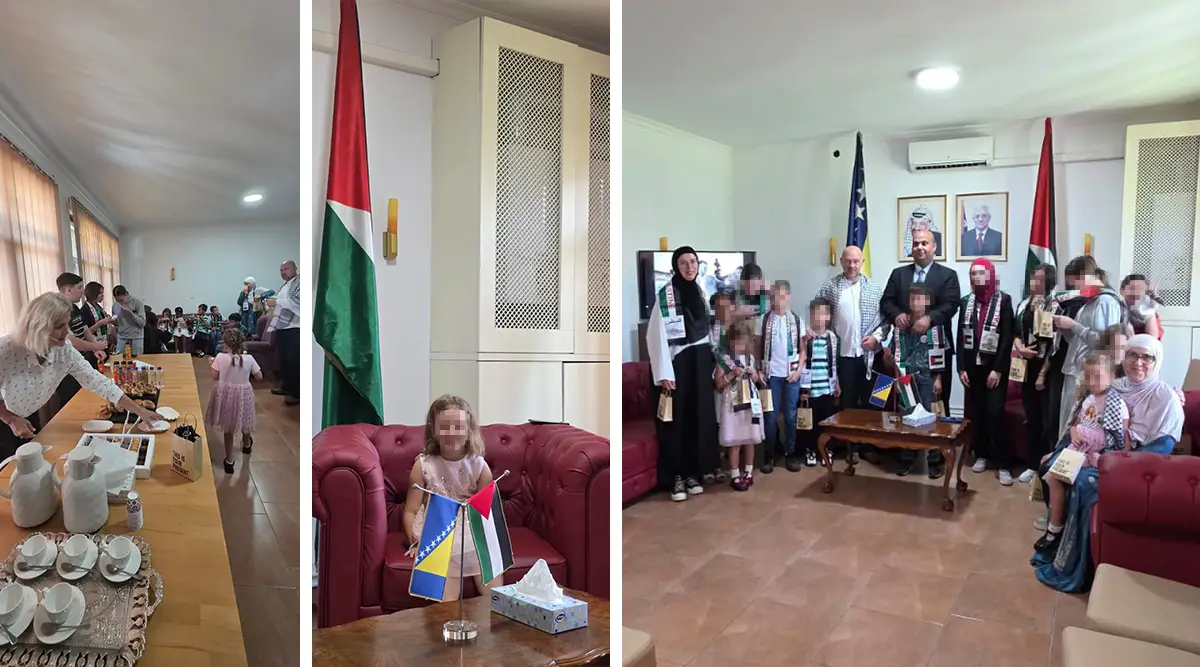
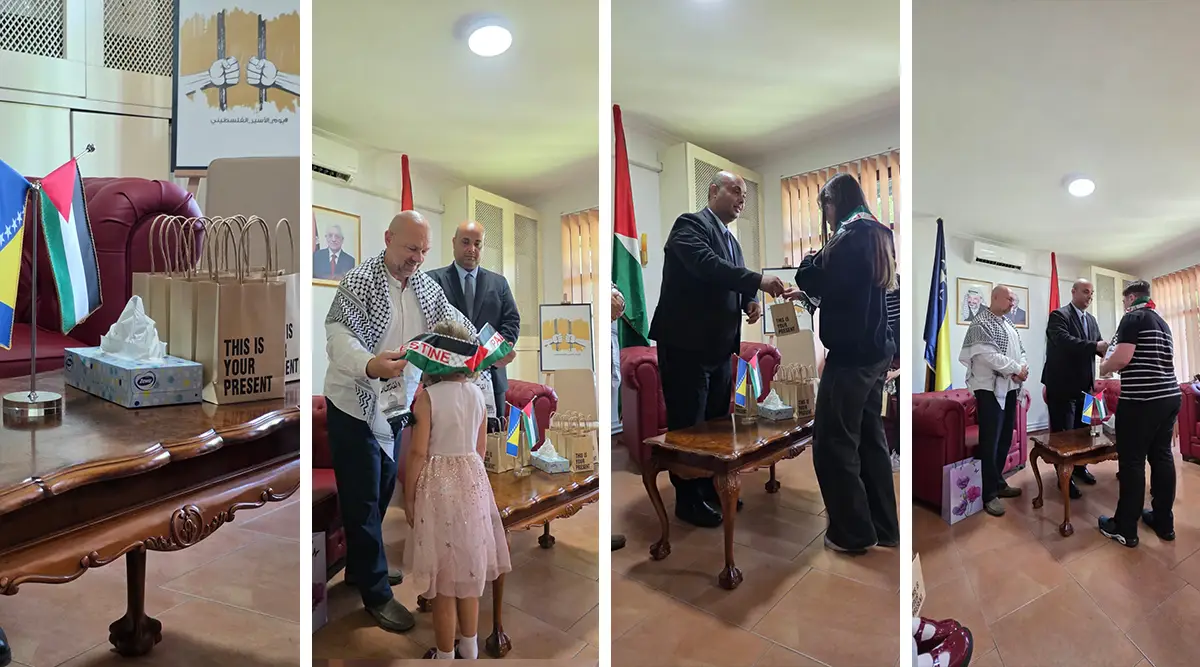
At the end of the visit, the hosts presented the children with gifts bearing the Palestinian flag and "Save Palestine" badges, after which everyone continued their gathering over light refreshments at the Embassy.
They parted with one shared wish—that one day children from Bosnia and Herzegovina and Palestine would speak to one another without video calls, without sirens and without war, but simply as friends who would remember that their friendship began in Sarajevo.
Today's meeting once again demonstrated that friendships are built not only between countries, but above all between people. When children come together, guided by adults who have themselves survived war and understand its true cost, hope is born that future generations will choose dialogue over conflict, education over hatred, and solidarity over indifference.